


The Three Numbers That Actually Determine Your Hot Shower in Winter
Every winter, the same forum debate fires up: tankless vs. tank for cold-weather RVing. And every time, the conversation circles around one number: BTU output. That focus misses the point entirely.
Three variables determine whether you get a hot shower or a lukewarm disappointment: BTU output, GPM flow rate, and incoming water temperature. These three numbers are inseparable. Change one, and the other two shift with it.
What most spec sheets don't make obvious: manufacturer BTU ratings are typically measured at a 35–45°F temperature rise, not the 65–80°F rise you actually need when groundwater drops into the 30s. That gap matters enormously.
A 66,000 BTU tankless heater pulling 35°F inlet water is functionally weaker than its spec sheet implies. Under specific cold-weather conditions, a 6-gallon tank heater can actually outperform it for shower consistency. That's not opinion; it's math.
This article breaks down the real physics behind cold-weather water heating, corrects three persistent forum myths, and gives you the framework to make a genuinely informed decision.
Why Your BTU Rating Is Only Half the Equation
BTU tells you how much heat energy a burner can produce per hour. It does not tell you how much hot water you'll get at the faucet. For that, you need to factor in the temperature rise required and the flow rate you're drawing.
The math is straightforward. According to Camp Addict, a 42,000 BTU tankless heater delivers only about 1.2 GPM at a 70°F temperature rise (35°F inlet water, 105°F target). That's barely enough for a comfortable RV shower, and it leaves zero margin for anyone else running a faucet.
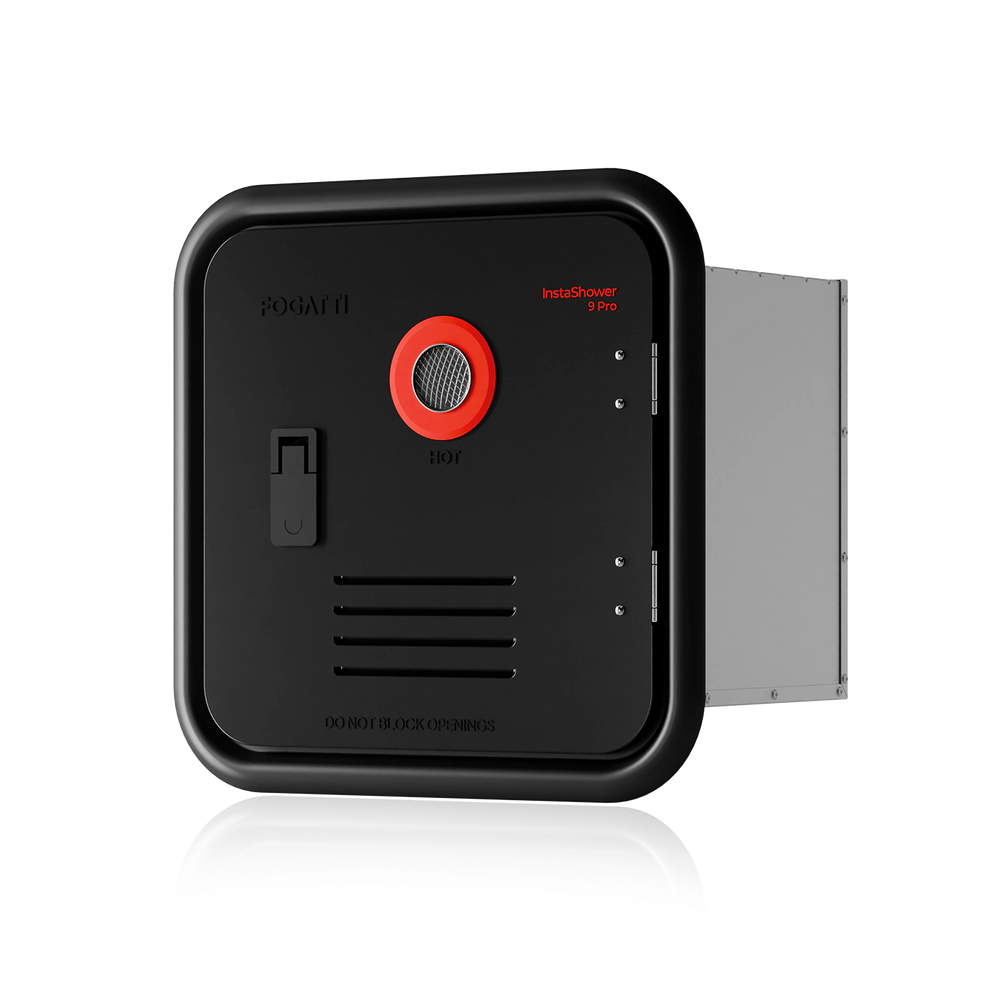
Step up to a 66,000 BTU unit, like the Fogatti 9 Pro, and you get roughly 1.9 GPM under the same conditions. That 0.7 GPM difference sounds small on paper, but it's the gap between a satisfying shower and one that feels like standing under a garden hose.
Most RV tankless heaters on the market fall between 34,000 and 66,000 BTU. Premium models reach 68,000 to 75,000 BTU. For winter campers, that range isn't just a product tier; it's the line between usable and frustrating.
Think of it as a formula: effective hot water output = f(BTU, inlet temp, target temp). All three variables move together. You can't evaluate one without the others.
For late fall camping with 40°F well water and a 105°F target, you need approximately 69,000 BTU to maintain adequate flow. That exceeds the capacity of most entry-level RV tankless units right out of the box.
The forum claim that "more BTU always means better cold-weather performance" isn't wrong exactly. It's just incomplete. A 55,000 BTU heater pulling 55°F summer groundwater will outperform a 66,000 BTU heater pulling 35°F winter groundwater. BTU without inlet temperature context is a meaningless comparison.
Incoming Water Temperature: The Variable Nobody Posts About
If you camp in mountain states like Colorado, Wyoming, or Montana, your incoming water temperature during cold months commonly sits between 35°F and 40°F. In some high-altitude campgrounds, it drops even lower. This single variable has more impact on your shower quality than any other factor, and it's the one forum threads almost never quantify.
The compounding math is punishing. A 58,000 BTU tankless heater rated for 1.8 GPM at 50°F groundwater drops to approximately 1.5 GPM when groundwater falls below that threshold. Same heater, same burner, less usable hot water. The physics don't care about your spec sheet.
Contrast that with a traditional tank-style RV water heater. A 6-gallon tank heats its stored water to 125–130°F regardless of incoming water temperature. Whether the inlet is 55°F or 35°F, the water sitting in that tank reaches the same temperature. That thermal buffer means you can mix at the faucet to a comfortable 105°F and still have plenty of hot water for a full shower.
The energy profiles tell an interesting story. A 6-gallon tank heater uses roughly 12,000 BTU/hour to maintain temperature, with brief spikes to 20,000 BTU during recovery. A tankless unit burns 42,000 to 66,000 BTU continuously while you're drawing water. The tank heater's thermal buffer isn't just old technology; it's an engineering advantage that stores heat energy over time instead of generating it all on demand.
One practical fix that almost no forum thread mentions: if you already own a tankless unit, raise your setpoint temperature in winter. This seasonal adjustment compensates for colder inlet water by telling the burner to work harder before modulating down. It won't solve every cold-weather problem, but it's the first thing to try before spending money on a replacement.
Inlet water temperature is the single biggest performance variable for any RV water heater. If you don't know your campground's groundwater temperature, you're guessing at performance.
The Propane Tank Is a Hidden Bottleneck, Not Just the Heater
Forum debates about tankless vs. tank almost always treat propane supply as a separate topic. It isn't. Your propane tank is part of the heating system, and in cold weather, it can become the weakest link.
Propane itself doesn't freeze in any conditions you'll encounter in North America. Its boiling point is -44°F. But vaporization rate — the speed at which liquid propane converts to usable gas — is directly affected by tank temperature, liquid level, and tank surface area. When a high-BTU tankless heater draws 42,000 to 66,000 BTU continuously, it pulls propane gas so rapidly that the tank self-cools through evaporative heat loss. The tank gets cold, vaporization slows, gas pressure drops, and your heater can't get the fuel it needs to maintain output.
The consumption numbers make this concrete. A 68,000 BTU tankless heater uses approximately 0.6 gallons of propane per hour at full output. A standard 20 lb tank provides roughly 40 showers before you need a refill. That sounds reasonable until you factor in cold weather.
Below 40°F ambient temperature, propane consumption for tankless heaters increases by 15–25% because the burner cycles longer to reach setpoint. That increased draw compounds the vaporization pressure problem. You're burning more propane while the tank is simultaneously less able to deliver it.
Tank fill level matters more than most people realize. A near-empty propane tank has less liquid surface area exposed to ambient air, which means less heat transfer and slower vaporization. In cold weather with a quarter-full tank, you can experience pressure drops that starve even a modest-BTU heater.
Practical tip: keep your propane tanks as full as possible during cold-weather trips, and if you're running a high-BTU tankless heater, consider using two tanks in parallel to increase total surface area for vaporization. This is a real-world fix that addresses a real-world bottleneck.
Altitude + Cold Water: The Double Penalty Mountain Campers Face
Mountain camping creates a compounding problem that flat-land RVers never encounter. At 5,000 feet, a propane tankless heater loses 10–15% of its effective BTU output due to reduced oxygen for combustion. Less oxygen means less complete combustion, which means less heat energy transferred to the water.
That penalty stacks directly on top of cold inlet water losses. A mountain camper in Colorado at 8,000 feet with 38°F groundwater faces both reduced combustion efficiency and maximum inlet temperature penalty simultaneously. Even a premium 66,000 BTU tankless unit is effectively operating as a 56,000–59,000 BTU unit while also needing to produce a 70°F temperature rise. The math gets difficult fast.
Tank heaters handle this scenario differently. The stored hot water in a tank is unaffected by altitude combustion losses during the shower itself. Yes, the tank heats more slowly at altitude because the burner is less efficient. But once that water reaches 125–130°F, it delivers consistently regardless of elevation. The slow recovery is a trade-off, not a failure.
Most RV tankless heaters are rated to perform at altitude limits around 9,000 feet, but real-world degradation begins well below that threshold. If you regularly camp above 5,000 feet in cold months, you're operating in the zone where spec sheet numbers diverge most from actual performance.
Actionable guidance for mountain campers: size up significantly in BTU. Target 68,000 to 75,000 BTU minimum for consistent cold-weather performance at altitude. A 75,000 BTU tankless heater can provide a 90°F temperature rise at 2.2 GPM; in January Montana conditions with 32°F groundwater, one tested unit delivered 122°F water at 2.0 GPM. When possible, pre-heat your water system before arriving at a high-altitude campsite to reduce the initial thermal load on the heater.
Three Forum Myths That Lead to Cold Showers, Corrected
Myth 1: The Cold Water Sandwich Is Just a Tankless Quirk
The cold water sandwich — that sudden blast of cold water mid-shower — is the #1 complaint about RV tankless systems on forums. Most discussions treat it as a fixed characteristic of tankless technology. It's not. It's a variable problem that gets dramatically worse in cold weather.
When the burner cycles off during a brief pause (turning off the shower to lather up, for example), cold water fills the heat exchanger. In summer, that cold water might be 60°F. In winter, it's 35°F. When the burner re-ignites, the temperature swing between that cold slug and the newly heated water is far more severe. The sandwich effect in January is a completely different experience than in July.
Myth 2: Mixing Cold Water at the Faucet Fixes a Too-Hot Shower
This sounds logical but creates a feedback trap. When you mix cold water at a single-handle faucet, you reduce the hot water draw through the tankless unit. If that reduced flow drops below the unit's minimum activation threshold, the burner shuts off entirely. Now you're getting only cold water — the exact opposite of what you intended.
This feedback problem is unique to tankless systems. Tank heaters store pre-heated water, so mixing at the faucet simply blends hot and cold without affecting any burner. If you have a tankless unit, adjust the setpoint temperature instead of mixing at the faucet.
Myth 3: Freeze Protection Rating Means the Heater Works in the Cold
Freeze protection and cold-weather heating performance are two entirely separate specifications. Freeze protection keeps internal components from cracking when temperatures plunge. It says nothing about how well the heater actually heats cold water.
Some units, like certain Furrion models, require winterization when outside temperatures drop below 39°F. Fogatti's tankless heaters include line freeze protection that extends operability in cold conditions. But neither specification tells you what flow rate you'll get from 35°F inlet water.
A single freeze event inside a tankless heat exchanger can crack the copper coil, warp solenoids, or damage the PCB control board. Traditional tank units with simple bypass kits rarely suffer this kind of catastrophic damage. Freeze protection matters, but don't confuse it with performance.
So Which Should You Choose for Cold-Weather RV Life?
The honest answer is conditional. There's no universal winner. The right choice depends on your camping elevation, typical groundwater temperature, propane tank size, and how you actually use hot water on the road.
Tank heaters win when:
- You regularly camp where groundwater drops below 40°F
- You're at altitude above 5,000 feet with small propane tanks
- Consistent shower temperature matters more to you than endless hot water
- You're a long-term full-timer; many report no problems even in single-digit °F temperatures
Tankless heaters win when:
- BTU is sized correctly for actual winter inlet temps (target 66,000–75,000 BTU for cold climates)
- Propane supply is adequate and tanks are kept full
- You understand minimum flow rules and avoid the mixing valve trap
- Weight savings and continuous hot water for multiple uses matter to your setup
If you're not sure which category fits your camping style, Fogatti's "Help Me Choose" advisor tool matches heater specs to real camping conditions, including elevation and seasonal temperature inputs. It's a faster path to the right answer than scrolling through 47 pages of forum debate.
Already own a tankless unit and struggling in cold weather? Try the seasonal setpoint adjustment first. Raising your target temperature by 10–15°F in winter compensates for colder inlet water without replacing the unit. It's the simplest fix available, and it works.
With 20+ years of engineering experience and OEM partnerships with brands like Forest River and Gulf Stream, Fogatti designs for real-world conditions, not just spec sheet numbers. Our 800,000+ customer community across 80+ countries provides the cold-weather performance data that drives our product development. These aren't lab results; they're observations from people who actually camp in January.
The Bottom Line: Stop Arguing BTU, Start Calculating Inlet Temp
Every forum debate about RV water heaters eventually becomes a BTU comparison. That's the wrong starting point. BTU, GPM, and incoming water temperature must all be evaluated together. A BTU number without a groundwater temperature is like a speed rating without knowing the road conditions.
The two most overlooked variables in these debates are propane vaporization pressure (your tank's ability to deliver fuel in cold conditions) and altitude combustion loss (the 10–15% BTU penalty that mountain campers face on top of everything else). Both compound cold inlet water problems, and both are almost never mentioned in the same thread.
Your concrete action item: look up the average groundwater temperature for your most common camping region. The USGS publishes this data by state and season. Use that number, not the manufacturer's spec sheet temperature rise, to evaluate any water heater you're considering.
For personalized guidance, use Fogatti's advisor tool or join our owner community to share your cold-weather setup. Thousands of RVers have already posted their real-world configurations, and the collective knowledge there is worth more than any single product review.
Your next hot shower in 30°F weather starts with knowing one number: your inlet water temperature. Everything else follows from there.
Sources
- Camp Addict — RV Tankless Water Heaters: GPM, BTU, and Real-World Performance Compared
- Forest River Forums — Tankless Water Heaters for Full-Time RVers in Cold Weather
- Keystone Forums — Pros and Cons of RV Tankless Water Heaters
- Tankless Geek — Best Tankless Water Heaters for RVs & Camping 2026
- Bound By Flame — 12 Best Tankless RV Water Heaters (November 2026)
- RV Travel — Am I Out of Propane? Or Is It Just Too Cold Outside?
- Sarah Lee and Johnny — 8 Best Portable RV Water Heaters
- Good Sam Community — Pros and Cons of Tankless Water Heaters in RV
- Vehicular — RV Tankless Water Heater: 1 Simple Setting Change That Fixes Everything
- eTrailer — Recommended RV Water Heater That Works Well in Freezing Temperatures
- RV Road Log — How to Winterize a Tankless Water Heater in Your RV
- MyGrandRV Forums — Tankless vs Tank Water Heaters: Real-World RV Experiences & Fixes