


Why Most RV Propane Estimates Are Wrong Before You Leave the Driveway
It's Day 9 of your 14-day boondocking trip in the desert. The morning air is cold, you flip on the furnace, and nothing happens. The propane is gone. Your trip is over five days early, and the nearest refill station is 40 miles away.
This scenario plays out more often than you'd think, and it's almost always preventable. The problem? Most online propane calculators list appliance BTU ratings and spit out a number, but they skip the single variable that determines real-world consumption: duty cycle. Without it, your estimate is fiction.
This guide walks you through a complete, worked 14-day propane budget combining your furnace, water heater, and cooktop into one running total. Every calculation starts from the same foundation: 1 gallon of propane = 91,500 BTU. That's the universal energy constant published by the Propane Education & Research Council, and it anchors everything that follows.
Here's what you'll learn: your furnace dominates the propane budget at roughly 70–80% of total consumption. Your water heater is secondary at 20–25%. And your cooktop? It's barely a rounding error at about 6%. We'll break each one down in full.
The Master Formula: Converting BTU Ratings Into Gallons Per Hour
Every propane calculation in this guide uses one core formula:
Gallons per Hour = Appliance BTU Rating ÷ 91,500
The 91,500 figure represents the total energy content in one gallon of liquid propane. It's a fixed physical property, not an estimate, so it works for every appliance in every RV regardless of brand or model year.
Here's a quick example using a 30,000 BTU RV furnace:
30,000 ÷ 91,500 = 0.328 gallons per hour
Simple enough. But here's the critical caveat: 0.328 gal/hr is the maximum consumption rate, assuming the burner fires continuously at full output. In reality, no furnace runs nonstop. The burner kicks on, heats the RV to the set temperature, shuts off, and waits until the temperature drops again.
That on-off cycling is called the duty cycle, and it's the modifier that most propane content completely ignores. It's also the reason most RVers either massively overestimate or dangerously underestimate their propane needs.
Furnace: The Dominant Propane Consumer in Your RV
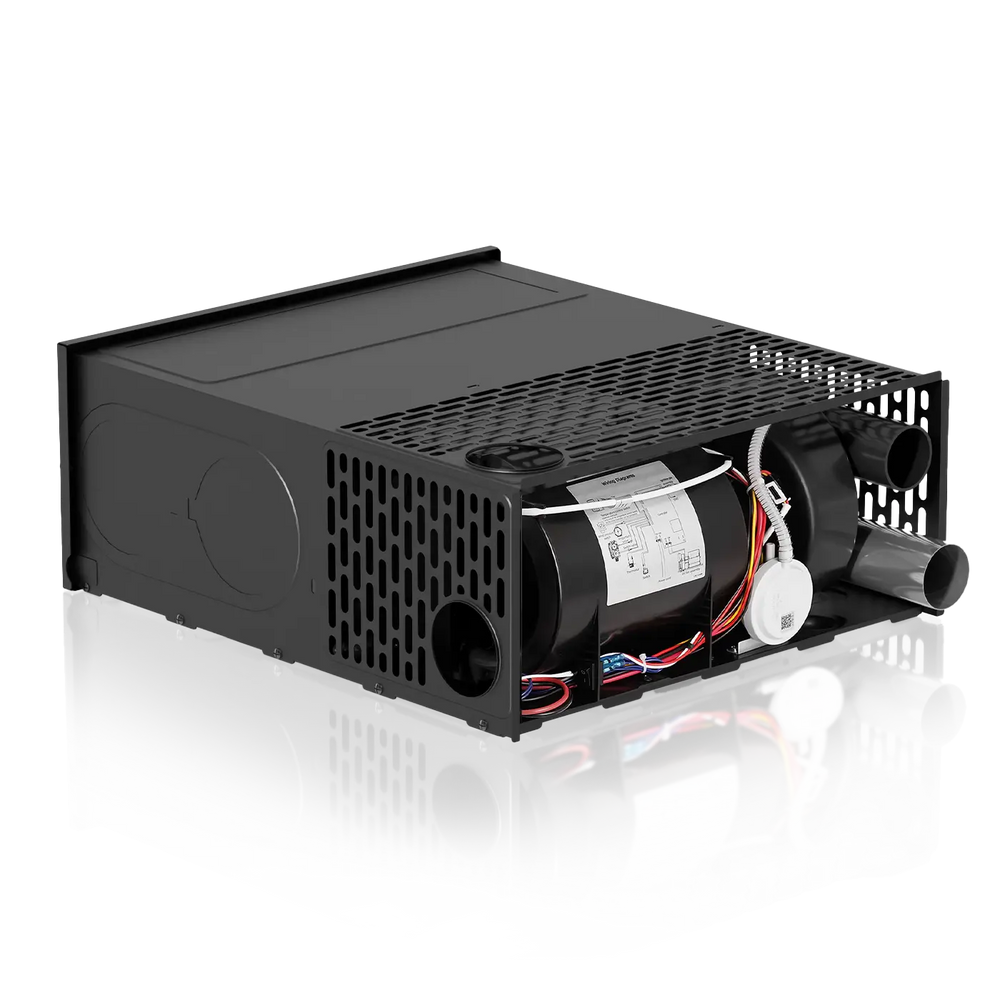
RV furnaces are rated between 20,000 and 40,000 BTU/hr, making them the single largest propane draw on any off-grid trip. According to data from Fogatti's RV Propane Academy, the furnace typically accounts for 70–80% of total propane consumption during a multi-day boondocking trip.
But the BTU rating alone doesn't tell you how much propane you'll actually burn. That's where duty cycle comes in.
Duty Cycle in Plain Language
Your furnace thermostat calls for heat, the burner fires, the RV warms up, and the burner shuts off. It might run for 12 minutes, sit idle for 8 minutes, then fire again. Over the course of an hour, the burner is only actively burning propane 30–60% of the time. That percentage is your duty cycle.
The Full Calculation, Step by Step
Here's a realistic cold-weather scenario with a 30,000 BTU furnace running 8 hours per night at a 40% duty cycle:
- Base consumption: 30,000 ÷ 91,500 = 0.328 gal/hr
- Adjusted for duty cycle: 0.328 × 0.40 = 0.131 gal/hr
- Per night: 0.131 × 8 hours = 1.05 gallons per night
Confirmed: 8 hrs × 0.328 gal/hr × 0.40 = 1.05 gallons per night. Over 14 nights, that's 1.05 × 14 = 14.7 gallons for furnace heating alone, which would exceed the capacity of dual 20 lb tanks.
(Note: A slightly milder profile, such as shorter nightly run hours or a lower duty cycle, yields roughly 0.84 gal/night and a 14-night total of about 11.8 gallons. The difference depends on how cold your nights actually get.)
Estimating Your Own Duty Cycle
Here's a rough guide based on overnight lows:
- Mild nights (50°F+): 30% duty cycle
- Cold nights (30–50°F): 40–50% duty cycle
- Sub-freezing (below 30°F): 60–70%+ duty cycle
In extreme cold, experienced boondockers report burning 1–2 gallons per day for heating alone. That can drain a 20 lb tank in as few as three days.
The Catalytic Heater Alternative
A catalytic heater like the Olympian Wave-6 uses roughly 0.3–0.5 gallons per day to maintain 65°F when it's 25°F outside. Compare that to 0.8–1.2 gallons per day for a forced-air furnace in similar conditions. That's a 50–75% propane savings, according to real-world data from Boondock or Bust. If you're planning extended cold-weather stays, a catalytic heater can fundamentally change your propane math.
Water Heater: Tank vs. Tankless and the Off-Grid Propane Difference
Your water heater is the second-largest propane consumer, but the type you use makes a significant difference over 14 days.
Tank Water Heater
A standard 6-gallon tank water heater runs at 8,800–12,000 BTU/hr. It doesn't just heat water on demand; it cycles on and off throughout the day to maintain tank temperature, even when nobody's using hot water. That standby cycling adds up to roughly 2–3 hours of actual burner time per day, consuming about 0.29 gallons/day.
Over 14 days: 0.29 × 14 = ~4.1 gallons for water heating alone.
Tankless Water Heater
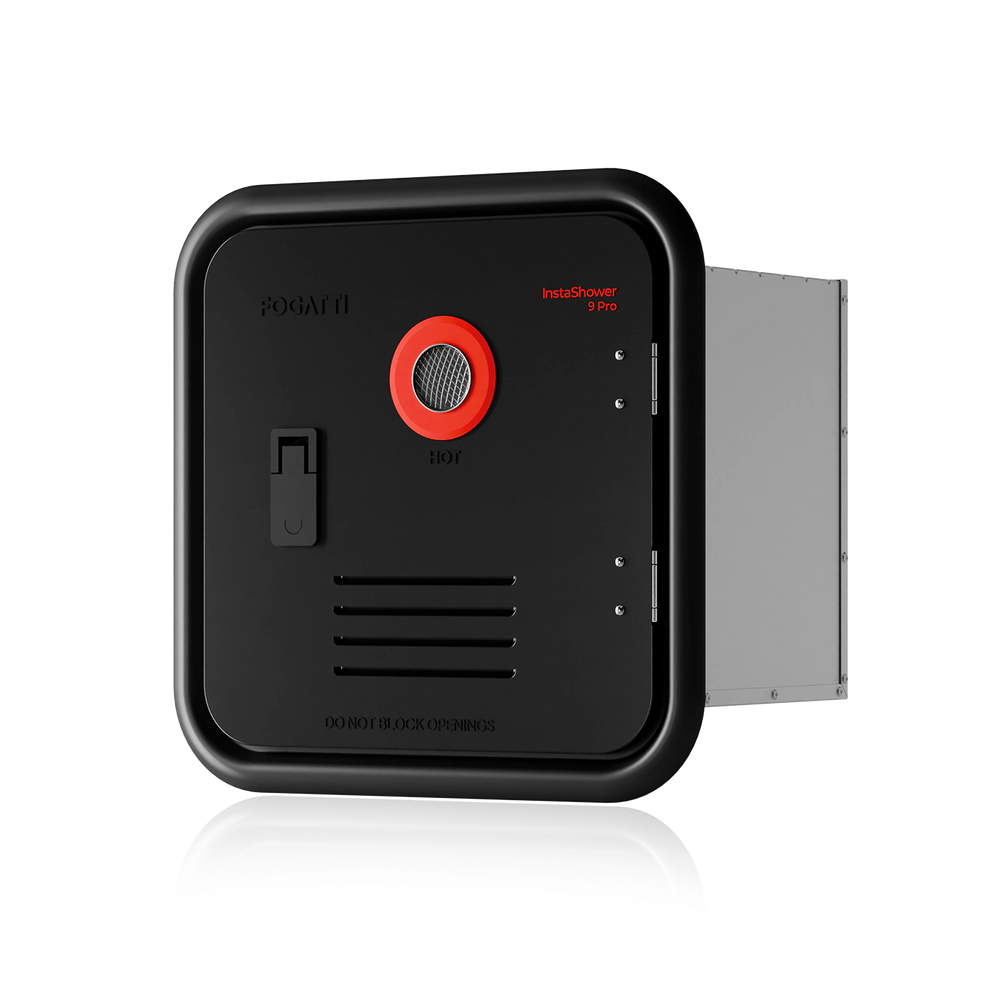
Here's where the math gets counterintuitive. A tankless unit fires at 35,000–66,000 BTU/hr, which sounds like it would consume propane rapidly. But it only burns fuel while water is actively flowing through the unit. No flow, no flame, no propane consumed.
Based on product comparison testing with Fogatti's tankless line (as a trusted OEM supplier to Forest River, Gulf Stream, and other leading RV manufacturers, we test these numbers rigorously), a tankless unit serving 1–2 people typically uses about 0.20 gallons per day.
Over 14 days: 0.20 × 14 = ~2.8 gallons. That's roughly 30–50% less propane than a tank heater, according to comparison data from The RV Surplus, despite the higher BTU rating.
Why This Matters Off-Grid
The key difference is standby loss. A tank heater burns propane to keep water hot whether you're showering, hiking, or sleeping. A tankless unit eliminates standby loss entirely. On a 14-day off-grid stay, that difference compounds into real gallons saved.
There's a water conservation angle too. Tankless heaters deliver hot water almost instantly, so you're not running the faucet waiting for it to warm up. When your freshwater tank is your only water source for two weeks, every gallon matters.
For reference, a full 30 lb propane tank provides roughly 10–14 showers from a tankless unit, depending on shower duration and temperature setting.
Cooktop: The Smallest Slice of Your Propane Budget
RV cooktop burners consume 6,000–9,000 BTU/hr per burner. Oven burners run at roughly 2,200 BTU/hr. Compared to your furnace and water heater, cooking barely registers on the propane meter.
Here's the math for a single burner at 6,000 BTU/hr:
- 6,000 ÷ 91,500 = 0.066 gallons per hour
- 1 hour of cooking per day = 0.066 gallons/day
- Over 14 days: 0.066 × 14 = ~0.92 gallons total
That's less than 6% of your total trip propane budget. The cooktop is the easiest appliance to budget because it's the most predictable and smallest draw. You control exactly when and how long it runs.
A practical tip: cooking larger batch meals (one-pot chili, stews, or a meal prep session every few days) reduces your daily burner time and trims even this small number further. Fewer dishes and less water used is a double win when boondocking.
Your Complete 14-Day Propane Budget: Worked Scenarios
Now let's combine all three appliances into a single 14-day total. Here are two realistic scenarios for a couple traveling together.
Scenario A: Mild Weather, 2 People
- Furnace (30,000 BTU, 30% duty cycle, 6 hrs/night): 6 × 0.328 × 0.30 × 14 = ~4.2 gallons
- Tankless water heater (0.20 gal/day): 0.20 × 14 = ~2.8 gallons
- Cooktop (0.066 gal/day): 0.066 × 14 = ~0.92 gallons
- Total: ~7.9 gallons
Dual 20 lb tanks (roughly 8–9.4 usable gallons) are sufficient for this scenario.
Scenario B: Cold Weather, 2 People
- Furnace (30,000 BTU, 40% duty cycle, 8 hrs/night): 8 × 0.328 × 0.40 × 14 = ~11.8 gallons
- Tank water heater (0.29 gal/day): 0.29 × 14 = ~4.1 gallons
- Cooktop (0.066 gal/day): 0.066 × 14 = ~0.92 gallons
- Total: ~16.8 gallons
This scenario requires dual 30 lb tanks at minimum.
The 80% Fill Rule (Don't Skip This)
Propane tanks are filled to only 80% of their rated capacity. This isn't a suggestion; it's a safety requirement to allow for thermal expansion. A "30 lb" tank yields roughly 7 usable gallons, not the full rated amount. A 20 lb tank holds about 4.6–4.7 gallons when properly filled.
And here's something many RVers learn the hard way: retail tank exchanges (the kind you grab at a hardware store or gas station) typically deliver only about 4.0 gallons into a 20 lb tank, not the full 4.7-gallon capacity. That missing 0.7 gallons per tank adds up fast over a 14-day trip.
Tank Size Recommendations
For a cold-weather 14-day off-grid trip with 2 people, dual 30 lb tanks are the practical minimum. If you're traveling with 4 people, running the furnace heavily, or heading into sub-freezing temperatures, consider dual 40 lb tanks or an ASME 25-gallon permanent tank. According to Camper Upgrade, a full-time 2-week trip with all appliances running requires roughly 15.4 gallons total, confirming dual 30 lb tanks as the baseline.
Two Hidden Variables That Can Blow Your Propane Budget
Altitude
If you're camping above 7,000 feet (common throughout the American West and Rockies), reduced oxygen levels cause your furnace to cycle longer to achieve the same heat output. The burner still fires, but combustion is less efficient, so it takes more run time to reach your set temperature. Your carefully calculated duty cycle goes up, and so does your propane consumption.
There's a safety dimension too. Incomplete combustion at altitude increases carbon monoxide production, as noted by Fogatti Living. Make sure your CO detectors are functional and tested before any high-altitude trip.
Mitigation: Add a 10–15% propane buffer to your budget for trips above 7,000 feet.
Moisture Generation
Here's a fact most RVers never consider: burning one gallon of propane produces approximately one gallon of water vapor as a combustion byproduct. Over a 14-day trip burning 15+ gallons, that's 15+ gallons of water vapor released into your RV interior. The result is condensation on windows, damp bedding, and real mold risk on longer stays.
Mitigation: Crack a vent or window when running the furnace for extended periods. A small 12V dehumidifier can also help manage interior moisture levels during multi-week boondocking trips.
What Your 14-Day Propane Budget Actually Costs in 2026
Propane isn't just a volume calculation; it's a dollar figure that varies significantly by location and season.
As of the week ending November 2, 2026, the US residential propane average is $2.82 per gallon, according to the EIA Weekly Heating Oil and Propane Survey. That's up 15% year-over-year from $2.44/gallon.
Applied to our two scenarios at the national average:
- Scenario A (7.9 gallons): 7.9 × $2.82 = ~$22.28
- Scenario B (16.8 gallons): 16.8 × $2.82 = ~$47.38
State-by-state variation is dramatic. North Dakota averages $1.84/gallon while Florida sits at $5.15/gallon. The same cold-weather 14-day trip (Scenario B) costs $30.91 in North Dakota versus $86.52 in Florida.
The 2025–2026 heating season average was $2.55/gallon, nearly flat compared to the prior year's $2.56, according to MyWild.report. The November 2026 spike to $2.82 signals seasonal volatility worth watching. Check the EIA's weekly propane price data before departure so you can plug a locally accurate price into your budget.
Build Your Pre-Trip Propane Checklist
Here's a step-by-step process to build your own 14-day propane budget before you leave:
- Look up your furnace BTU rating (check the data plate on the unit). Estimate your nightly run hours and assign a duty cycle: 30% for mild nights, 50% for cold, 70% for extreme cold.
- Identify your water heater type. Tank heater? Use 0.29 gal/day. Tankless? Use 0.20 gal/day for 2 people.
- Estimate daily cooking time and multiply by your burner BTU ÷ 91,500. Most couples use about 1 hour per day.
- Sum all three appliances × 14 days, then add a 15% buffer for altitude, unexpected cold snaps, or extra guests.
- Apply the 80% fill rule to your tank size(s). Confirm you have enough usable propane, not just rated capacity. Remember: retail exchanges often deliver only ~4.0 gallons into a 20 lb tank.
- Check current propane prices for your destination state and multiply your gallon total for a dollar budget.
Not sure which water heater is right for your rig? Fogatti's "Help Me Choose" advisor tool can match the right tankless water heater to your RV and usage pattern. Switching from a tank to a tankless unit can cut your water heating propane by 30–50%, which over a 14-day trip translates to real gallons and real dollars saved.
Don't Let Propane Be the Reason Your Trip Ends Early
Duty cycle is the single most important variable most RVers miss. Without it, your furnace estimate is either wildly overstated (scaring you into hauling extra tanks) or dangerously understated (leaving you cold on Day 9).
Here's the 14-day hierarchy one more time:
- Furnace: ~70–75% of total propane
- Water heater: ~20–25%
- Cooktop: ~5–6%
If you're looking for the single appliance upgrade with the clearest propane ROI on a 14-day off-grid trip, it's a tankless water heater. Lower daily consumption, zero standby loss, and water conservation as a bonus. That combination matters more with every day you spend off-grid.
One final note: experienced boondockers don't just calculate their propane budget once. They track actual consumption trip by trip, refining their personal duty cycle estimates based on real conditions. Your first calculation is a starting point, not a final answer. Each trip makes the next estimate more accurate.
We'd love to hear from you. If you've tracked your propane numbers on a 14-day (or longer) off-grid trip, share your data in the comments or in our community forum. Real-world numbers from real RVers are the best way to help fellow travelers calibrate their budgets and stay out longer.
Sources
- RV/Van Life Propane Usage Calculator — Complete Calculators
- RV Propane 101: Calculate Exactly How Much You Use — Fogatti Academy
- How Long Will a Propane Tank Last While Boondocking? — Boondockers Bible
- Winter Boondocking Tips and Gear — Boondock or Bust
- Tankless vs Tank RV Water Heater: The Complete Comparison Guide — The RV Surplus
- RV Tankless Water Heaters: GPM, BTU, and Real-World Performance Compared — Camp Addict
- RV Propane Usage Calculator — Camper Upgrade
- RV Appliances at High Altitude — Fogatti Living
- Propane Cost Per Gallon 2026 — PropaneCostPerGallon.com (EIA data)
- Heating Oil and Propane Prices by State 2026 — MyWild.report (EIA data)