


Getting an RV warm isn’t always the difficult part. Keeping it comfortable through the night without constant furnace starts and stops can be another story.
A furnace may warm the cabin quickly, shut off once the thermostat reaches the set temperature, then start again as the RV loses heat. During the day, that cycle may barely register. At night, when the RV is quiet, the blower starting up with each new heating cycle can make those repeated starts and stops much more noticeable.
The issue isn’t always that the furnace needs more heating power. Sometimes it’s about how quickly heat is delivered, how quickly the RV loses it, and how the furnace responds as conditions change.
Why Does an RV Furnace Cycle at Night?
Your thermostat controls when the furnace needs to run. When the temperature around it falls enough below your setting, it calls for heat. The furnace begins a heating cycle and continues until the thermostat is satisfied. Once the set temperature is reached, heating stops and the blower completes its shutdown cycle. As the RV gradually loses heat, another cycle begins.
How often this happens depends largely on the balance between how quickly the furnace adds heat and how quickly the RV loses it. Outdoor temperature, thermostat setting, insulation, windows and doors, airflow, and furnace output can all affect that balance. A higher-output furnace may bring the RV to the set temperature more quickly, but it cannot prevent heat loss after heating stops.
Thermostat location matters too. It measures the temperature where it is installed, which may be different from the temperature in your sleeping area. If it is near a warm-air outlet, it may reach the set temperature before the rest of the RV feels equally warm. If it sits in a colder, draftier area, it may call for heat more often or keep the furnace running longer.
Frequent nighttime cycling does not automatically mean the furnace is too small or that something has failed.
When Should Frequent Cycling Be Checked?
Some cycling is normal. What deserves attention is unusually brief heating cycles or a sudden increase in how often the furnace turns on and off, especially when the RV is no longer maintaining the temperature you want.
If the furnace shuts down before reaching the set temperature, produces weak airflow, repeatedly fails to ignite, or shows a fault code, the issue may involve airflow, power, ducting, or another operating condition rather than ordinary thermostat cycling.
There is no single “normal” cycle length for every RV. A better way to judge the system is to consider whether it maintains the desired temperature, whether its behavior has changed under similar conditions, and whether other symptoms appear.
For basic checks, read RV Furnace Not Working? 5 Things to Check First. Changing the heating level or selecting Sleep Mode should not be used to work around repeated protective shutdowns.
What Can Make Nighttime Heating Less Disruptive?
If the furnace is operating normally but the repeated starts and stops are still noticeable, first look at avoidable heat loss. Windows and doors should close properly, and worn seals or noticeable drafts are worth addressing. Keep required ventilation openings clear, and make sure bedding, luggage, or furniture does not block heat outlets or return-air openings.
Heating output also affects how the furnace cycles. Lower output does not stop cycling; it changes how quickly the RV reaches the thermostat setting.
If a lower output is still enough to keep up with the RV’s heat loss, the cabin warms more gradually and the furnace can stay on longer before the thermostat is satisfied. Over the same period, those longer heating cycles may mean fewer restarts—and fewer noticeable blower startups during the night.
That only works when the lower output can meet the current heating demand. If outdoor temperatures fall and the RV loses heat faster than the furnace can replace it, a higher output is needed. If your furnace offers selectable heating levels, follow its instructions and try a lower setting while you are awake before relying on it overnight.
Simply choosing a permanently smaller furnace is not necessarily the answer. It also limits the maximum capacity available when the RV is cold or outdoor temperatures drop further. Different heating levels provide flexibility without giving up the higher capacity needed in colder conditions.
Use only settings supported by your equipment. Do not restrict vents, modify wiring, or bypass safety controls to make the furnace quieter or force its blower to run continuously.
When Different Heating Levels Make More Sense
For some RVs, the challenge is not simply choosing between a higher-output or lower-output furnace. You may need more heating capacity to warm a cold cabin or handle colder weather, but that same level of output may not be necessary once the RV is comfortable and you are settling in for the night.
That is where having multiple heating levels in the same furnace becomes useful. Instead of giving up higher capacity altogether, you can choose an output that better matches the conditions.
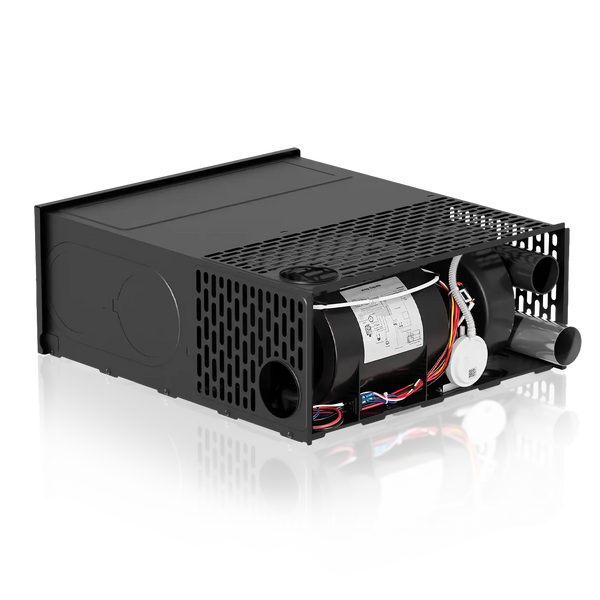
The FOGATTI InstaHeat 35K offers four manually selectable heating levels: 17K, 25K, 30K, and 35K BTU. Higher output is available when the RV is cold or heating demand is greater, while lower levels can be selected as that demand drops.
For overnight use, Sleep Mode runs at 17K BTU with reduced blower speed and lower burner output. The furnace still turns on and off as needed to maintain the set temperature. When 17K is enough to keep up with your RV’s heat loss, the gentler heat delivery can extend each heating cycle and help reduce how often the furnace restarts during the night.
Sleep Mode also has a rated noise level of 40 dB, helping make furnace operation less noticeable when the RV is quiet. You are not giving up higher heating capacity for a quieter night—you still have more output available when conditions call for it.
If your RV does not need 35K at peak heating demand, a smaller furnace may still be the better fit. But for RVs that do, the InstaHeat 35K gives you the flexibility to warm a cold cabin quickly, then step down to gentler overnight heating as demand decreases.
Any replacement still needs to match your RV’s installation, ducting, airflow, gas, and electrical requirements.
Up to 35K for greater heating demand. A quieter 17K Sleep Mode when less heat is needed.