

America's Biggest RV Dealer Just Lost $320 Million: Here's What That Means for You
There are roughly 52 million camping households across the United States right now. People are still hitting the road in record numbers. Yet Camping World, the nation's largest RV retailer, just posted a $320.1 million net loss in Q3 2026, including a staggering $287 million goodwill impairment charge.
What does "goodwill impairment" mean in plain English? It means the company formally admitted that the retail stores it acquired over the years are worth far less than what it paid for them. That's not a rough quarter. That's a written confession that the retail model itself is broken.
Camping World's CEO called this "the weakest new RV retail environment in over 15 years" during the Q2 2026 earnings call. This isn't doom-and-gloom for RV owners, though. It's the opposite. The traditional dealer channel for RV appliances is cracking open, and direct-to-consumer buyers stand to benefit the most.
Walk through why this moment is the smartest window in years to upgrade your rig's appliances without ever stepping foot in a dealership.
The Numbers Behind the Collapse: What Camping World's Data Actually Shows
The headline loss is dramatic, but the underlying numbers tell an even clearer story. Camping World sold just 15,126 new RVs in Q3 2026, a 25.4% drop year-over-year. Used RV sales slipped 8.1% in the same period. The company's Q3 revenue of $1.58 billion missed Wall Street's forecast by $70 million.
Profitability is evaporating even faster. Adjusted EBITDA in the RV and Outdoor Retail segment collapsed 76% year-over-year, falling from $77.2 million to just $18.2 million in Q3 2026. The company closed or consolidated 13 store locations in the 12 months ending March 31, 2026, with additional closures confirmed in October.
This isn't isolated to one company. Lazydays RV, another major retail chain, was acquired by Campers Inn RV in 2025 after its own financial distress. The entire large-format RV retail sector is consolidating.
New RV retail registrations, tracked by Statistical Surveys Inc., fell every single month from January through May 2026: down 14.51% in January, 24.12% in February, 21.87% in March, 16.87% in April, and 19.04% in May. RVIA's Summer 2026 RoadSigns forecast projects wholesale shipments of just 314,000 units at the median, an 8.2% decline from 2025's 342,200 units.
When the nation's largest RV retailer writes down $287 million in asset value, cuts over 1,500 employees, and watches its stock drop roughly 83.65% over five years, the dealer-centric model for buying RV products isn't just weakened. It's structurally compromised.
Why RV Owners Are Holding Their Rigs Longer and Upgrading Instead
New RVs depreciate 10 to 20% in the first year alone. High-end models can lose nearly 50% of their value. When you run those numbers against the cost of upgrading the appliances in your current rig, the math becomes obvious: upgrading what you own is dramatically more cost-efficient than buying new.
Most part-time RV owners already keep their rigs for 7 to 10 years. That cycle is stretching even further as owners choose to hold rather than trade up in a soft market. Private RV sales surged 111% year-over-year in mid-2025, with owners bypassing dealer trade-ins entirely. That kind of shift signals deep consumer distrust of dealer pricing structures.
The used market is strong from every angle. Used towable RVs at auction were up 13% in mid-2025. Even Camping World's own used RV sales rose 5.2% in Q2 2026 while its new sales cratered. Owners are clearly choosing the "hold and upgrade" path.
The broader market data backs this up. The RV Appliances Market was valued at $2.5 billion in 2025 and is projected to grow at a 7.0% CAGR, reaching approximately $4.6 billion by 2034. Aftermarket channels already command 55.8% of distribution and are growing at 9.4% CAGR. With 52 million camping households and 31% of campers planning more nights outdoors in 2026, the demand isn't for new units. It's for comfort upgrades to existing rigs.
The Dealer Markup Math Nobody Talks About for Appliances
Here's where the rubber meets the road for your wallet. RV dealer markup on parts and accessories typically runs 20 to 40% above invoice. Installed appliances carry even steeper margins. An appliance that costs a dealer $300 at wholesale can retail for $500 to $600 once you factor in the installed price at a service counter.
Contrast that with direct-to-consumer pricing. Online and DTC channels are the fastest-growing distribution segment in RV-adjacent markets, expanding at 12.3% CAGR, and they reduce consumer pricing by 10 to 15% compared to traditional retail.
Consider a tankless water heater. Purchased direct from the manufacturer at transparent pricing, you're looking at a straightforward cost with free shipping included. Walk into a dealership for the same upgrade, and you're paying the markup on the unit itself plus labor rates that have climbed as service departments shrink. The gap can easily run $150 to $250 on a single appliance.
That service availability problem is getting worse, not better. With Camping World cutting 1,500-plus full-time employees and closing stores across the country, dealer installation is both more expensive and harder to schedule than it was two years ago. Wait times are longer. Coverage areas are thinner.
Brands that publish transparent pricing and back it with free shipping and price guarantees are winning consumer confidence precisely because dealer pricing opacity has eroded trust. Camping World's stock, down roughly 83.65% over five years, tells you that investors and consumers alike are voting with their feet.
Which Appliances to Prioritize When You're Upgrading an Existing Rig
If you're holding your rig longer or you just picked up a used RV, three appliance categories deserve your attention first.
Tankless water heaters are the single most-requested upgrade among used RV buyers and long-term owners. On-demand hot water eliminates the limitations of a traditional tank system, reduces propane waste, and delivers a noticeable quality-of-life improvement on every trip. The RV tankless water heater category is one of the highest-growth aftermarket segments right now.
Rooftop air conditioners matter more than ever as owners extend their camping seasons into warmer months. The RV AC market reached $1.35 billion globally in 2024 and is projected to grow at 7.2% CAGR through 2033. Efficiency and quiet operation are the top priorities for buyers, especially those camping in parks with noise restrictions or shore power limitations.
Furnaces and heating systems are critical for shoulder-season and full-time campers. Aging furnaces in 5 to 10 year old rigs are a real reliability risk, and replacing them with a direct-purchase unit avoids the dealer service appointment entirely.
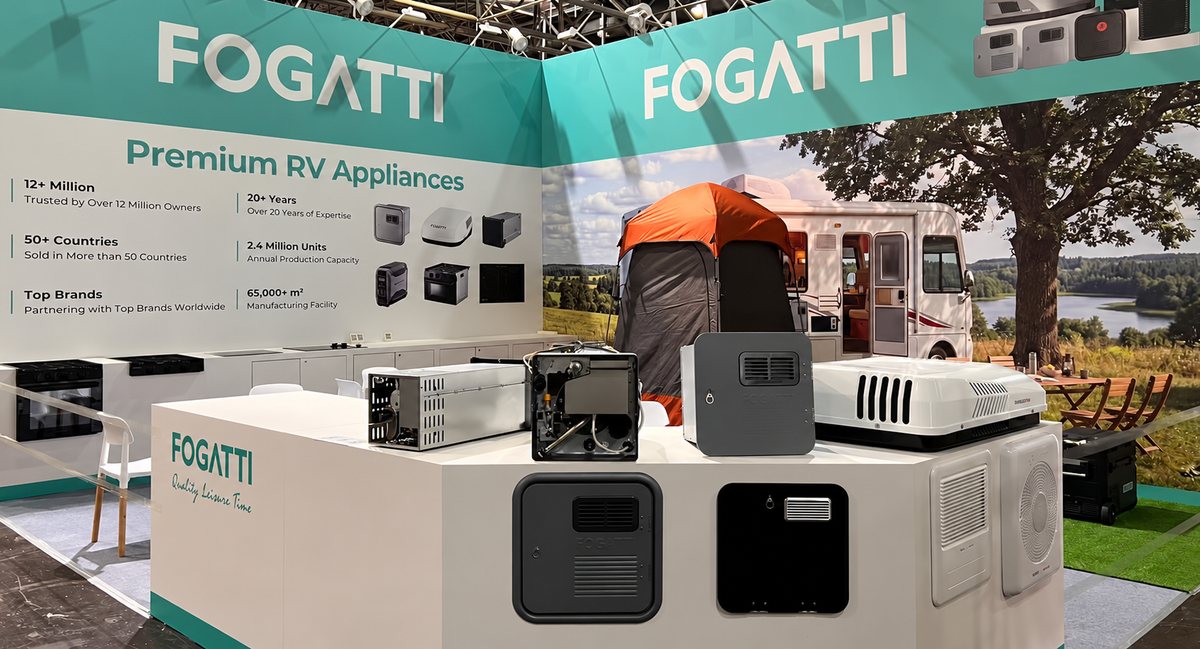
If you just bought a 2 to 3 year old used RV, these three categories should be your first assessment. Not because they're necessarily broken, but because upgrading them now costs far less than a dealer service call later. Fogatti's Help Me Choose advisor tool can match the right appliance spec to your specific rig type (travel trailer, fifth wheel, camper van, or motorhome) without requiring a dealership visit.
What to Look for When Buying RV Appliances Direct
Not every direct-to-consumer brand deserves your trust. Here are the five filters that separate reliable manufacturers from discount resellers.
- Warranty length and coverage. A 2-year warranty signals genuine manufacturer confidence in build quality. Shorter warranties on dealer-installed units often reflect third-party liability hedging, not product strength.
- OEM supplier credibility. Brands that supply appliances directly to RV manufacturers like Forest River and Gulf Stream have already passed rigorous engineering validation. That's a meaningful quality signal when you're buying aftermarket.
- Free shipping and price guarantees. Dealer freight and installation fees can add hundreds of dollars to an appliance purchase. Policies that eliminate those costs directly offset any perceived convenience of buying local.
- Community proof. Real owner reviews, hands-on installation stories, and creator-documented installs are more reliable indicators of real-world performance than anything you'll hear on a dealer sales floor.
- Transparent pricing. If a brand publishes its prices openly and stands behind them with a guarantee, that tells you more about its confidence than any sales pitch.
Warranty, OEM credentials, transparent pricing, shipping policy, and community validation. Run every direct-purchase decision through those five filters, and you'll land on brands built for the long haul.
The Window Is Open, But It Won't Stay That Way
Camping World's documented collapse (13 store closures, a 25% new-unit sales drop, a $287 million write-down, and $1.4 billion in long-term debt) has created a structural gap in the traditional dealer channel. Direct-to-consumer appliance brands are filling that gap right now.
RV owners who upgrade today lock in current direct pricing before any tariff shifts or supply chain disruptions tighten margins. That 10 to 15% DTC pricing advantage over retail is real, and it's time-sensitive.
The RV owners thriving in 2026 aren't waiting for the dealer market to recover. They're upgrading what they have, camping more nights, and sharing those stories with a community that gets it. Since 2003, over 800,000 customers across 80-plus countries have made that same call with Fogatti.
Ready to find the right upgrade for your rig? Use Fogatti's Help Me Choose tool to match the right appliance to your specific setup. Free shipping, a 2-year warranty, and zero dealer markup. Just the upgrade your rig deserves.